בָּרוּךְ הַבָּא בְּשֵׁם יְהוָה

Have you ever wondered why there are 60 minutes in an hour? We’re a decimal civilization, so why not 100 minutes? France actually tried using a decimal hour (along with some other irredeemably awful ideas that the French seem to have a knack for) from 1793 to 1805, but it never caught on, even under the constant threat of statist violence that we’ve come to expect from authoritarian/dirigiste regimes like Robespierre’s Reign of Terror.

We owe our thanks for the 60-minute hour to the Sumerians and Babylonians, whose civilizations used a sexagesimal (base-60) numbering system. In the days before calculators, a numbering system base with lots of factors greatly facilitated division and multiplication, and the number 60 has ten factors–2, 3, 4, 5, 6, 10, 12, 15, 20, and 30–in contrast to the number 10, which only has two factors–2 and 5. So the Babylonians used sexagesimal numbering for all their calculations and measurements, including those for time, until their empire was conquered by the Persians in 538 BC. The Persians made great use of base-60 numbering and also used the 360-day calendar, making adjustments periodically to align it with the 365.25-day solar year. This is similar to how the Hebrew lunar/solar calendar is adjusted seven times over a 19-year period to align it with the 365-day calendar.

By the 20th Century, there were so many different calendars referenced in the historical record, and each calendar had been adjusted or altered so many times, that when historians tried to construct a reasonably accurate picture of global history they had to team up with astronomers. All calendars are based on observations of the Sun and Moon (and some other stars/planets that are visible without a modern telescope), so historians and astronomers can wind back the motions of our solar system and, using historical information (e.g., “In the 12th year of the reign of Gluteus Maximus, when the Moon was aligned with Uranus ….”), can orient many historical events to our modern Gregorian Calendar, sometimes with astonishing precision.

For example, British/Irish author Sir Robert Anderson combined astronomical data with the historical record of Nehemiah, the royal Cup-Bearer to King Artaxerxes I of Persia, to determine that King Artaxerxes’ decree to rebuild the walls of Jerusalem was issued on 14 March 445 B.C. Though not a formally trained historian, Anderson had a keen analytical mind well honed through his career as a barrister and investigator with Scotland Yard. He published his thorough calculations and reasoning in “The Coming Prince.” Anderson’s dating of Artaxerxes’ decree is significant not just for its precision but also in its reference to the work of a Babylonian/Persian astronomer named Belteshazzar, who wrote some time between 530 and 540 B.C.: “From the time the word goes out to restore and rebuild Jerusalem until the Anointed One, the ruler, comes, there will be seven ‘sevens,’ and sixty-two ‘sevens.'”

Belteshazzar was culturally Babylonian/Persian but ethnically Hebrew and better known by his Jewish name: Daniel. “Anointed One” is a sobriquet for the Messiah, Who Daniel wrote would come 69 seven-year periods (483 years) after Artaxerxes’ decree. Because Daniel was then an astronomer in the Babylonian/Persian court, he used 360-day years, so this is equivalent to a period of 173,880 days. Taking 14 March 445 B.C. in the modern Gregorian calendar and winding the solar system forward 173,880 days, Anderson arrived at 6 April 32 A.D. Regardless of whether Anderson got it exactly right, it’s certain that the 1st-century Judeans, weary of Roman rule, had agreed on particular dates and had been diligently keeping a running count. This was after all an extremely important day on which they expected the Messiah to arrive in fulfillment of Zechariah 9:9, and so emboldened crowds formed at the gates of Jerusalem, under the watchful eye of the Roman garrison and the religious authorities, to sing from Psalm 118, “Blessed is he who comes in the name of the Lord!” (“Baruch haba b’Shem Adonai!”). Accounts of this event are recorded in all four Gospels (Matthew 21, Mark 11, Luke 19, and John 12).

The bona fides of that donkey’s Rider were immediately disputed (and remain in dispute), primarily by those who expected (or rather hoped) all of the messianic prophecies to immediately transpire–especially the one where the Annoited One asserts real political authority–instead of in phases over many centuries. And it had not occurred to the religious authorities that they might first witness the fulfillment of Isaiah 53:

“Surely he took up our pain and bore our suffering, yet we considered him punished by God, stricken by him, and afflicted. But he was pierced for our transgressions, he was crushed for our iniquities; the punishment that brought us peace was on him, and by his wounds we are healed. We all, like sheep, have gone astray, each of us has turned to our own way; and the Lord has laid on him the iniquity of us all.”

(By the way, if you’re not keen on reading the Hebrew scriptures or dismiss them as kooky and marginal, you can hear many of these prophecies summarized in what’s arguably the greatest work of all Baroque music, “The Messiah,” by G. F. Handel.)

For members of an elite scholarly caste ostensibly dedicated to studying all aspects of the Tanakh (including the prophecies of Daniel), this oversight was no simple “honest mistake.” To know the exact day and hour but not the season is at the very least a serious misalignment of priorities, and 40 years after that misalignment (40 being a very significant number in Hebrew numerology), the Roman army destroyed the Second Temple and scattered Judeans so far abroad that Marco Polo found centuries-old synagogues in his exploration of China some 1,200 years later. Jesus (who was not only 100% Jewish but what we today would consider an ultra-orthodox practitioner of Mosaic Judaism), fittingly rebuked the scribes and Pharisees for their hypocrisy and conceit, whereas we today might be more inclined to let it slide.

Ironically, we not only have devices for measuring time down to the femtosecond, but we can also explain and predict how time can be distorted by even slight variations in speed and gravity. Unlike the Babylonians, we can tell you at any given moment exactly what day, hour, and second it is, absolutely anywhere; we just can’t tell you the epoch. The 5-day weather forecast is full of information but frequently useless, exit polls don’t seem to mean anything anymore, and not even the best Las Vegas odds maker can tell you what tomorrow will bring.

Today is the day of salvation. Tomorrow? Only God knows.


Leave a Comment

Filed under Uncategorized

A Four-Year-Old’s Catechism ….

Daddy: Who are you?
Audie: I’m your son.
D: What does that mean?
A: You Buzz-Lightyear love me.
D: What’s Buzz-Lightyear love?
A: To infinity and beyond.
D: How can I Buzz-Lightyear love you?
A: Because you have two Dads.
D: Really?!? How can I have two Dads?
A: Because you were born two times.
D: And if I was born two times, what does that mean?
A: You can only die once.
D: And if can only die once, how long do I live?
A: Forever.
D: Right. And I’ll love you as long as I live, so how long will I love you?
A: To infinity and beyond.
D: Right! So how many Dads can you have?
A: Two: you and God.
D: Exactly ….
A: What about Buzz Lightyear?
D: Um, that would be more than two ….
A: And Fox in Socks?
D: We’ll … review this … tomorrow night ….

Leave a Comment

Filed under Uncategorized

Primordial soup for the skeptical soul

Last October I posted an excerpt from a probability text demonstrating how the Infinite Monkey Theorem, which is often cited as an example of how chance can be both a causal agent and a plausible explanation for the origin of information, is not particularly meaningful (given what we now know about the Universe being finite). The excerpt ends with a reference to another “more controversial” example from the same text (Roberts, Richard A. “Independence and Repeated Trials.” An Introduction to Applied Probability, Addison-Wesley, 1992, pp. 89–91), which I promised to post as well. So here it is ….


Example 3.5.3

In 1953, two important scientific discoveries were reported. In England, James Watson and Francis Crick published their results on the structure of DNA, deoxyribose nucleic acid, the genetic code of life. In Chicago the same year, Stanley Miller and Harold Urey published results of their “origin of life” experiments in which they were able to produce amino acids from electrical energy and inorganic matter, i.e., chemicals. These two discoveries have subsequently been shown to be related through the theory of chemical evolution.

Chemical evolution is the evolution of first life from inorganic chemicals. In the scenario of chemical evolution, the first living cells are thought to have evolved from chemicals in a series of steps. The first step was the creation of the basic molecules needed to form proteins, DNA, RNA, and membranes. The first experiments of Miller and Urey were concerned with the formation of amino acids, the “building blocks” for proteins. These basic molecules are thought to have occurred in a “primordial soup” and, through repeated independent trials, to have formed into long chains to produce proteins, DNA, RNA, and other organic compounds needed by the first living cell. These organic molecules then combined to form a proto cell and, finally, the first living cell. In this example, we shall consider one aspect of chemical evolution, the chance formation of proteins from the amino acids that make up proteins in living cells. Thus we shall assume that all of the 20 different amino acids needed in protein synthesis were available as building blocks. Nineteen of the 20 amino acids needed in living cells occur in two forms, which we shall denote as left-handed and right-handed. They occur in approximately equal numbers. But only left-handed forms appear in living cells. Thus there are effectively 39 possible choices of amino acids–19 left-handed forms, 19 right-handed forms, and one amino acid that is neither.

An hypothesized mechanism by which these amino acids join together is “random,” i.e., repeated independent trials. The question is as follows. Is “chance,” i.e., the independent concatenation of amino acids, a reasonable mechanism for the appearance of first life? Let’s calculate the probability of forming one protein made up of 400 amino acids. A length of 400 is not, in fact, a large protein, but it is somewhat average.

To begin the calculations, let’s assume that the 20 different kinds of amino acids occur in equal numbers, i.e., 400/20 = 20 of each kinds in our hypothetical protein. Let’s perform the calculation in two steps. Suppose we assume that the correct kind of amino acid is selected for each of the 400 locations in our protein. “Chance” is required to select only left-handed (versus right-handed) forms. That is, what is the probability of selecting 380 left-handed forms from a 50/50 mixture of left- and right-handed forms? (We use 380 because one of the 20 kinds of amino acids occurs in one form only.) This probability is the same as the probability of 380 heads in 380 throws of a fair coin. Thus

P[one protein, left versus right] = (1/2)^380 approx {10^-114.4}.

Now suppose both the sequence of amino acids and left-handedness are selected by “chance.” What is the probability of forming a single protein, 400 amino acids long, that is

P[one protein] = (1/2)^380(1/20)^400 approx {10^-635}?

This is analogous to the probability of forming a specific sequence in one trial, i.e., the probability of event A_k in Example 3.5.2.

Now suppose we have a great number of trials N. What is the probability of formation in this case? If A is the event “form one protein,” then

P delim{[}{A}{]} <= {N}/{10^635}, N = number of trials

by the same reasoning used in Example 3.5.2.

To create a large number of trials, let’s assume that every molecule in all the oceans on earth is an amino acid equally divided among the 39 forms. Assume that these amino acids link up in sets of 400 every millisecond for 10 billion years. What is the probability of forming a single protein in 10 billion years, that is

P delim{[}{A}{]} <= {N}/{10^635}?

The number of trials is

N = {(}(10^45 molecules(amino acids))/(400 amino acids-per-set){)}(10^3 sets/sec)(10^7 sec/year)(10^10 years) = 10^65/400.

And so,

P delim{[}{A}{]} <= (10^65/400)/10^635 = 10^-590/400 <= 10^-590.

Thus any attempt to build a probabilistic model for protein formation, based on independent concatenation of amino acids, would assign probability zero to this event and discard independent trials as a plausible mechanism. “Chance” is not a reasonable mechanism to form a single average-length protein, much less all the other proteins, DNA, RNA, and membrane molecules needed to produce a living cell.

Some may argue that the entire 400-acid-long protein need not form in one simultaneous connection of 400 amino acids. Rather, the formation might occur with smaller units hooking up and then coming together in several steps. If the events of the amino acids coming together were independent, then it makes no difference how they are formed–whether in small chains or in one connection of 400. The probability of formation is the same.


Why should this example be controversial? The math is sound, basic, and almost self-explanatory, and it’s been reinforced over some 27 years since the publication of Roberts’ book (you can see some good related content here and here and here and here). To anyone who’s been paying attention, it’s clear that chemical evolution (and, I would argue, Darwinian Naturalism) has been fatally discredited as a valid explanation for the origin of life.

I think Roberts called this example “controversial” either because most people have not been paying attention or they’re bothered not by the evidence but rather by the implications of the evidence.

Because those implications are objectively moral and contradict the sacred credos of postmodernism, the controversy is therefore philosophical, not scientific (as Roberts noted).

More on that later ….

Leave a Comment

Filed under Uncategorized

All Peanuts of Our God and King ….

Just over two years ago my daughter was born six weeks premature at 3 pounds 13 ounces, which is why we sometimes affectionately call her “Peanut.” Like her brother, she’s precociously smart and mischievous. Unlike her brother, she was born with her eyes wide open: As we sang the Doxology and all eyes stared at us (“What are those weirdos singing?”), it surprised me to notice that one pair of eyes was my daughter’s. Most newborns don’t fully open their eyes for a few days, but Peanut came out of the gate looking at everything. When the staff moved her to an incubator and I went with them, a nurse told me that as long as I was going to be in the way I might as well shield Peanut’s peepers from the harsh light, so I did. I doubt she blinked once. Before my daughter’s personality began to emerge her eyes gave us clues. They’re happy, pensive and kind, and she communicates with them. I also think she sees things that most people don’t, and I won’t be surprised at all if she becomes an artist of some sort. She already shows an affinity for drawing and coloring (mostly on paper, fortunately, but sometimes on furniture, unfortunately).

It sounds crazy, but eight days after Peanut’s birth, a bunch of women were stomping around Washington, D.C. dressed up as female reproductive organs. As far as I can tell, these women were protesting what they perceived as an infringement of their civil rights, namely the alleged right of my wife to have killed my daughter if she were still in the womb. Ironically, one organizer of the mass vajayjay-stomp, Linda Sarsour, is a proponent of sharia law, the Islamic legal code that, where practiced, deprives women of their most basic rights, including the right to vote, hold public office, drive cars, be secure in their own persons and property, dress up like a giant hoo-ha, and so on and so forth. On YouTube, I saw a counter-protester at the March for Life “educating” pro-lifers on the finer scientific points of fetal ontogeny by screaming “It’s just a clump of cells!”–which is a claim that even honest pro-abortion advocates admit is scientifically untrue.

I thought a lot about what I desire most for my daughter, and while I’m still clarifying that, I do know for certain already that I want her to know the truth. Almost every other desire I have for my daughter could be subsumed in that because the truth will best guide the trajectory of her life. For example, I want her to have the moral courage to fight injustice, but I want her to know what injustice truly is rather than waste her time fighting ghosts. I want her to know that she’s beautiful based on a true concept of beauty rather than the objectifying “beauty” of our contemporary culture. I want her to know what love truly is: an arduous journey of dedicated work, humility, and self-sacrifice, not vacuous politeness, flattery and virtue signaling. I want her to know that, contrary to the reductive philosophy of the pu**y-hat mob, she is infintely more than a set of body parts and perceived grievances. I want her to know that she has–and has always had, even when she was an alleged “clump of cells”–the unalienable rights to life, liberty, and the pursuit of happiness. I want her to never settle for less than her full potential. I want her to know that she’s not the result of an accidental collision of amino acids that just happened to assemble themselves in a fictitious primordial soup. And I want her to know that she’s not a powerless victim adrift in a sea of randomness and evil, but rather that her life has inestimable meaning, purpose, and value because she was created by a sovereign God Who loves her, has a plan for her life, and truly empowers her.

The biggest obstacle I’ve encountered is that most people don’t want to know or seek the truth. By default, the truth is unpopular, especially today as the prevailing (and inherently contradictory) trend in western thought is that there is no “absolute” truth and that all truths are confined to their own particular social and historical contexts. But truth was no more esteemed nearly 2,000 years ago when the Roman prefect of Judea dismissively quipped “What is truth?” before turning Jesus over to the baying mob. The world demanded His brutal public execution because He told the unvarnished truth, but even pleasant truths are often rejected (just listen to my wife when I tell her how beautiful she is). We may praise truth passively, but we actively and tirelessly suppress it. And as Western civilization continues to decay, I’ve noticed a persistent refrain among its antagonists: Those who suffer due to their departure from the truth that makes civilization possible try to persuade everyone else about the validity of their perverse subjective morality, often when they clearly don’t believe in it themselves and even exploit the innocence of children in attempting to buttress their own tottering psychological defense mechanisms.

Supressing the truth is a tireless task because the truth is infinitely enduring (and if you’ve concluded that truth is ultimately an attribute of an infinitely enduring Person, as C.S. Lewis did, I would agree with you). Truth comes back to bless or haunt you, whether you like it or not. This happens on the individual as well as the societal level. Ravi Zacharias once posed this rhetorical question to a hypothetical multi-culturalist:

“In some cultures they love their neighbors, and in some cultures they eat their neighbors. Do you have a preference about what kind of culture you’d like to live in?”

His point was that cultural disagreements over morality aren’t proof that there is no objective moral truth because while different cultures disagree about what is right and wrong, civilizations must embrace some key common values simply to endure. For example, a culture that doesn’t promote courage is unlikely to produce a competent fire department. A culture that doesn’t value honesty isn’t going to have a sound economy, because we need to be able to trust each other to do business. A culture that doesn’t enforce equal justice under the law can’t expect citizens to respect the law. Such cultures are incompatible with civilization, and civilizations that embrace these cultures will certainly fail. Conversely, civilization can’t even begin without an incubation of compatible culture, which is why people living in uncivilized cultures tend not to have roads, writing, currency, etc. Everyone is too busy preparing for the next internecine conflict or otherwise coping with the chaos of their uncivilized world. This is true regardless of racial groups or geography, from the highlands of 20th-century New Guinea to the highlands of 17th-century Scotland. The extent to which we have a healthy civilization is in direct proportion to our embrace of objective moral truths that are congruent with human nature.

Another instance of objective moral truth is the inherent value of children, regardless of how their mothers (or the New York state legislature or Ralph Northam) may feel about them. The phrase “demography is destiny,” often attributed to the French agnostic philosopher Auguste Comte, is demonstrably true even to moral relativists, and if they take an honest look down the road of civilization, they can’t help but foresee the slow-motion collision between “choice” and demographic reality. But again, these collisions can be both societal and deeply personal. Agronomist Norman Borlaug, who received the Nobel Peace Prize in 1970 for his work to end world hunger, had just died in 2009 when I heard a comedian joke on late-night TV, “I was hungry yesterday, so I made myself a sandwich. Where’s MY Nobel Prize?” Moral obtuseness makes for good comedy in the postmodern world, and after living and working in the eminently postmodern Boulder area for almost 20 years, I think I have some insight. People in Boulder County are famously solicitous about the welfare of prairie dogs–just read letters to the editor of the Boulder Daily Camera for a few years, and you’ll know what I mean–but they’re also very supportive of abortion, even late-term abortion. So what’s the particular social and historical context in which it’s okay to condone killing a child (and even hardened abortion advocates will admit it’s a child) but not okay to condone killing prairie dogs? To be blunt, the context is nothing more than narcissistic convenience. For the virtue-signaling activist, advocating for prairie dogs will earn the easy praise of bien-pensant progressive peers; but attending a prayer vigil outside an abortion clinic will get you cursed at, spat upon, and possibly even physically assaulted. Of the potential parent, prairie dogs ask nothing; but children demand constant care and attention lasting many years. Also, children are expensive to raise, feed, and educate; but selling their body parts might just earn you enough to buy a Lamborghini. That’s really all there is to it. When you look beyond the exhibitionistic moral preening and self-congratulatory bombast of the prairie-dog cult, you can see people simply saying, “I was hungry, so I made myself a sandwich. And I’m awesome, so where’s my Nobel Prize?”

But here’s a better quote about being hungry:

“I was hungry … and you gave me something to eat. I was thirsty and you gave me something to drink. I was a stranger and you invited me in. I needed clothes and you clothed me. I was sick and you looked after me. I was in prison and you came to visit me.”

Certainly not stand-up comedy, but when we learn what we’re truly here for, it’s what we’ll long to hear. It’s what will forever run through our minds whenever we have time alone to think about what really matters.

“I was hungry, and you gave me something to eat.”

“I was born six weeks premature, 3 pounds and 13 ounces, and you sang with joy over me.”

“I was colicky at 2 AM, and you paced the floor with me and kissed the tears off my face.”

“I pooped in the bath tub, I was artistic with the furniture, I was mischievous and inconvenient, but you were patient with me.”

“You loved me well. You showed me the Truth.”

Leave a Comment

Filed under Uncategorized

Time flies like an arrow; fruit flies like a banana ….

Desultory meditations on time from my soon-to-be four-year-old son and my two-year-old daughter:

Audie: Hey, Daddy. What time is it now?
Peanut: When rabbit comes ….
Daddy: It’s getting late. Almost eight o’clock.
A: Wow! That’s even later than tomorrow night!
D: Yeah–wait. What?
P: White rabbit ….
A: Why did the girl throw her clock out the window?
D: I think because she–
A: Because she wanted to see time fly! Ha! Hey, Daddy ….
P: White rabbit late!
D: For a very important date?
A: Daddy, is tomorrow’s yesterday … yesterday’s … tomorrow?
D: Um …. I think … so. Yes! Had to think about it, but it sounds right.
P: When rabbit comes! Unbirthday ….
A: Why did the girl throw her bed out the window?
D: I don’t know. Why?
A: Because she wanted to see bed fly!

Leave a Comment

Filed under Uncategorized

Apocalypse Dad ….

Dad: Hello, Joe! I understand you’re taking my daughter to the prom!
Joe Shmoe: Yes.
D: Excellent! Please step into my office and have a word.
JS: … Okay …. What … is this place?
D: It’s my man cave! What do you think?
JS: You certainly … own a lot of FIREARMS. And … instruments of–
D: Yes! Lots of very interesting stuff in here!
JS: Who’s THAT?
D: The portrait? That’s my great, great, great, great, great, great, great, great, great grandfather Lord Alisdair Dad, the Seventh Earl of Carnage.
JS: Huh. Wait, Earl of … what?
D: Yes, he had to emigrate VERY hastily to North America back in 1763.
JS: Why?
D: Well, he … he was involved in a … a murder trial.
JS: A MURDER trial?
D: Yes, he … well, a young man of low reputation … leered at his daughter and couldn’t keep his hands to himself, and that young man subsequently disappeared under somewhat … suspicious circumstances.
JS: Suspicious?
D: Yes, and his body was discovered a year later at the bottom of a VERY deep sandstone quarry.
JS: Really?
D: Well PARTS of his body. Certainly not the entire–ENOUGH of his body to determine whose it was, let’s just say.
JS: Mr. Dad … are you … threatening me?
D: Threaten–what? No! Nononononononononono …. ‘Threat’ is such an ugly word. Let’s just say this is … A FAMILY TRADITION.
JS: Can I go now?
D: Young man, you can leave ANY TIME YOU WANT. Just bring back my little girl at 10:00 PM.
JS: How about 9:30?
D: Sounds great! Have fun!

Leave a Comment

Filed under Uncategorized

It really comes together when Mom plays along ….

Audie: Daddy, why didn’t it snow on Christmas? I thought it always snows on Christmas.
Daddy: Well, this was just the first day of Christmas. It’s supposed to snow on Wednesday, which is the second day of Christmas. There are twelve days of Christmas.
A:Why didn’t it snow on the first day of Christmas?
D: Because on the first day of Christmas, Mommy gave to me a partridge in a pear tree. And partridges hate snow.
A: Why?
D: They just don’t like cold weather. That’s actually why Susan Dey moved to San Pueblo, California. It never snows there.
A: Oh ….
A: Mommy, why did it not snow on Christmas?

Leave a Comment

Filed under Uncategorized

Dieu et mon droid ….

Yesterday, while Mommy and Peanut were napping and otherwise recovering from the stomach flu, Audie and I watched an episode of “Babar” (Season 5, 1991) called “Robot Rampage” in which Babar’s brother-in-law Arthur creates a robot, Robo-Bob Junior, that threatens to replace the Finance Minister (Pompadour) and Prime Minister (Cornelius). However, Robo-Bob Junior has some serious bugs and also cannot admit when it’s making mistakes. It also has no “reset” button, so when Robo-Bob runs amuck, Arthur has to shut it down with a paradox of contradiction:

Bob Junior: I AM ROBO-BOB JUNIOR. YOU CAN CALL ME BOB JUNIOR.
Arthur: I am Arthur. You can call me Arthur.
Bob Junior: I KNOW YOU, ARTHUR. YOU MADE BOB JUNIOR. YOU DID A GOOD JOB.
Arthur: Thanks. But actually when I made you, I made a … mistake.
Bob Junior: IT IS NOT POSSIBLE! ARTHUR MADE ROBO-BOB JUNIOR! ARTHUR DOES NOT MAKE MISTAKES!
Arthur: Oh, so when I said I made a mistake, I guess I was mistaken.
[The confused robot chatters nonsense and begins to melt down.]
Arthur: But if I DON’T make mistakes, then when you said I made a mistake, YOU must have made a mistake!
[The robot collapses into a smoking heap.]

Fans of the original “Star Trek” (1966–1969) will notice a similarity to “I, Mudd” (Season 2, Episode 8), in which Captain Kirk and the outlaw Harry Mudd talk Norman the Android to death using the Liar Paradox:

Kirk: Everything Harry tells you is a lie. Remember that! Everything Harry tells you is a LIE!
Mudd: Now listen to this carefully, Norman. I am lying!
Norman: You say you are lying, but if everything you say is a lie then you are telling the truth, but you cannot tell the truth because everything you say is a lie, but …. You lie, you tell the truth; but you cannot for you …. Illogical! Illogical! Please explain! You are human! Only humans can explain their behavior! Please explain!

The writers of “Babar” and “Star Trek” probably didn’t intended this, but they managed to illustrate a few points about why Darwinian Naturalism is not a valid explanation for the origin of the mind. In the case of Arthur, his robot creation (which is a deterministic automaton lacking free will) has limitations because Arthur himself has limitations. The episode’s story line shows how Arthur is as reluctant to admit that Robo-Bob needs dramatic improvement as he is proud of his creation, and these flaws are reflected in Robo-Bob’s malfunctioning. Yet if we replace Arthur with an unconscious, unguided process of random events–starting with the supposed self-assembly of proteins necessary for life–we don’t even get a logical/deterministic machine, let alone our own conscious mind. Oxford mathematician John Lennox points to his laptop and asks the Darwinian naturalist:

“If you knew that your computer was the end product of a mindless, unguided process, you wouldn’t trust it for a moment, would you? And yet to do your science, you trust something that you believe has come to be without any mind behind it whatsoever.”

We can say that a mindless, unguided process won’t even result in a logical/deterministic machine because nothing created can ever be more complex or ordered than its creator; a purely materialistic process therefore can’t result in anything capable of grasping basic principles of logic or of being confused by a paradox because these principles have no basis in the materialistic world. Mind simply does not follow from an arrangement of matter, as British scientist J.B.S. Haldane said:

“It seems to me immensely unlikely that mind is a mere by-product of matter. For if my mental processes are determined wholly by the motions of atoms in my brain I have no reason to suppose that my beliefs are true. They may be sound chemically, but that does not make them sound logically. And hence I have no reason for supposing my brain to be composed of atoms.”

So we’re not robots or deterministic machines that have merely an illusion of consciousness because we clearly have the free will to make choices, and we’re not the result of mindless, unguided processes because we are still subject to a demonstrably objective moral law and truth that necessarily point to something or Someone transcendent:

“Supposing you hear a cry for help from a man in danger. You will probably feel two desires – one a desire to give help (due to your herd instinct), the other a desire to keep out of danger (due to the instinct for self-preservation). But you will find inside you, in addition to these two impulses, a third thing which tells you that you ought to follow the impulse to help, and suppress the impulse to run away. Now this thing that judges between two instincts, that decides which should be encouraged, cannot itself be either of them. You might as well say that the sheet of music which tells you, at a given moment, to play one note on the piano and not another, is itself one of the notes on the keyboard. The Moral Law tells us the tune we have to play: our instincts are merely the keys.” (Excerpted from “Mere Christianity” by C.S. Lewis)

The Mind-Body Problem remains an insurmountable obstacle to proponents of Darwinian Naturalism for reasons that aren’t difficult for even a three-year-old to understand (but as George Orwell said, “There are some ideas so absurd that only an intellectual could believe them”) and Audie at least seems to get the gist of this intuitively, with an exploding robot thrown in as a bonus.

Leave a Comment

Filed under Uncategorized

Public Anomie No. 1 ….

When I was an agnostic, I had a strong sense of morality, but I never bothered (or maybe just never dared) to think about where it came from, and so often in the same breath that I affirmed the subjectivity of truth, especially moral truth, I used terms like “good” and “evil,” expecting that my own subjective sense of these terms would be universally understandable. That’s a contradiction that fellow agnostics and atheists never called me out on because, I’m convinced, they simply weren’t aware of it. And this contradiction is not a trivial one because the whole edifice of postmodernism/multiculturalism is built on it: The claim–that all truth is confined to its own social and historical context and is therefore subjective–is itself a truth claim. Maybe it’s easier to paraphrase a conversation from the classroom:

Professor: There is no such thing as absolute truth!
Student: Really? Is that true?
Professor: Absolutely!

This fundamental contradiction inherent to postmodernism shows why it’s frankly incompatible with civilization. If I point to a color and say “That’s blue,” and you point to the same color and say “That’s red,” it doesn’t mean that all viewpoints are equally valid; it just means that we can’t have a meaningful conversation about color. And if we can’t agree on any truths of our common existence (isn’t that what those “coexist” bumper stickers are about?) we simply can’t have a civilization, the most fundamental unit of which is the family. That’s why when people say, “I don’t know how I’m going to talk to my family this year at Thanksgiving dinner because I don’t even know what pronouns to use,” I could say we’re likely witnessing the collapse of our civilization. Because it’s not merely a new postmodern variation of the age-old holiday dinner awkwardness that we can’t even agree on something as fundamental as gender.

And another clear sign of civilizational collapse, one related to gender, is what’s happening to the Boy Scouts of America (BSA). When I became an Eagle Scout in the early ’90s, an older Eagle Scout in his late middle age grumbled that “Back in our day, you REALLY had to earn it.” I was somewhat offended by that but over the years, as I’ve witnessed a continuing degradation of the BSA’s standards and the concurrent abasement of masculinity (another important redoubt of civilization) in the Western world, I’m forced to agree with older scouts. In contrasting today’s BSA with the BSA of the early 20th century, Dr. Steve Turley notes:

“… rather than shape the boy into an objective vision of moral manliness and masculine virtue, the modern Boy Scout vision is a therapeutic vision that seeks to cultivate the self in highly personal and private and subjective terms. Indeed, while the first handbook began with a lengthy introduction exhorting boys to embrace their journey towards manhood, the modern version actually begins with a section on victimization and how to protect your children from child abuse. The original Boy Scout sought to foster virtue while the modern Boy Scout is encouraged to think of himself as a potential victim.” (Emphasis mine)

I’m saddened by this, of course, and not surprised that the BSA may soon be filing for bankruptcy, but I’m also hopeful that the original spirit of the scouting movement, which you can read more about at The Art of Manliness, seems to be continuing in a few promising new organizations: Trail Life USA, and the Royal Rangers. I’m also encouraged that for every civilization-friendly institution that’s under attack, there seems to be a corresponding pushback or instance of what Turley calls retraditionalization:

“In the face of threats to a sense of place, identity, and security so often posed by globalization, populations tend to reassert historic identity and security markers, like their religion, custom, and tradition as mechanisms of resistance against secular globalization’s anti-cultural, anti-traditional dynamics. Scholars are increasingly noting that as people feel vulnerable, it’s not uncommon for them to reassert their customs, traditions, culture, language, ethnicity, as bulwarks against threats to their sense of existential security.”

I would count Trail Life USA and the Royal Rangers as potential examples of retraditionalism, and while Turley doesn’t use the term “retraditionalization” in a pejorative way (as I assume most scholars would), I still have to take issue somewhat with his language here. Maybe it’s just a misperception on my part, but Turley seems to be characterizing retraditionalization mainly as a visceral, fear-based reaction; yet I think proponents of retraditionalization actually have a very soundly reasoned justification that globalists/postmodernists have either not heard or have carelessly dismissed. And it’s really not a difficult argument to make. Ravi Zacharias simply points out that even moral subjectivists lock their doors at night:

“I don’t think the question is fairly stated as, ‘What are you afraid of?’ I’m just saying it is basically unlivable. I didn’t conclude that. Atheists like Jean-Paul Sartre have concluded it.”

Knowing this, that even honest atheists and agnostics (and not just the survivors of Eastern and Central European Communist autocracy) have concluded that the ever shifting moral relativism of the postmodern/globalist world is not viable, I have good reason to hope that there might be more to our future than Rod Dreher’s despairing Benedict Option or passive assimilation into a doomed civilization.

Leave a Comment

Filed under Uncategorized

Little Archimedes ….

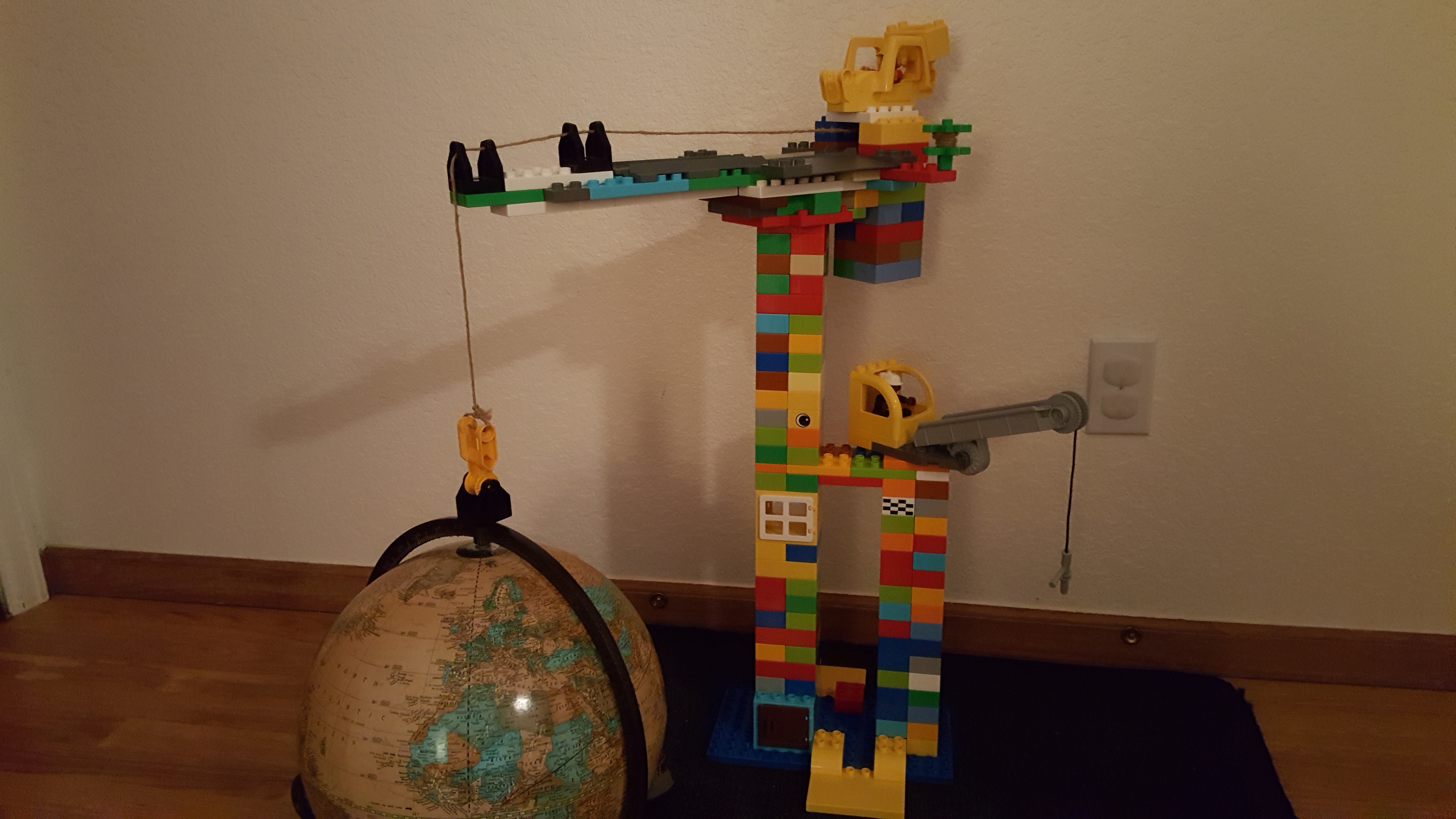
Given freedom and guidance, a child’s mind will inevitably glorify its limitless Creator. Without a finance officer to tell you that your ideas are too expensive, a project manager to tell you that you’re behind schedule, or a technical “expert” to tell you that your vision is implausible and stupid, you can accomplish some amazing things:

A fire truck ladder and railroad tracks can become crane arms, two flowers can become a capstan, and you might even move an entire world.

Leave a Comment

Filed under Uncategorized